
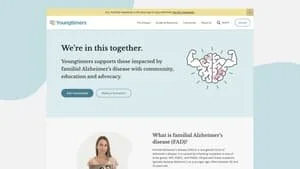

A Home for the Familial Alzheimer's Community
Youngtimers, a 501(c)(3) nonprofit supporting individuals and families affected by early onset familial Alzheimer's disease (FAD)
Serving families across every stage of an inherited disease
Familial Alzheimer's disease is a rare, inherited form of Alzheimer's caused by mutations in the PSEN1, PSEN2, or APP genes. People who carry a mutation typically develop symptoms in their 30s, 40s, or 50s, and their children each face a 50 percent chance of inheriting it. Families navigate genetic testing decisions, caregiving, family planning, and clinical trial participation, often across multiple generations at once, and often with no local expert who has ever seen the disease.
Youngtimers was founded in 2020 by members of the FAD community to fill that gap with community, education, support, and research advocacy. But as a young, volunteer-run organization, its early website couldn't keep pace with the community it served. Information was hard to find, the site was difficult for volunteers to maintain, and there was no infrastructure connecting website visitors to support groups, events, or donor relationships.
Slide UX brought something unusual to this engagement: our founder is a PSEN1 mutation carrier, and a member of the Youngtimers board. She understands firsthand what a newly aware family member needs at 2am and what a caregiver in crisis can actually absorb. That’s why she devoted her time to this particular project as a volunteer.
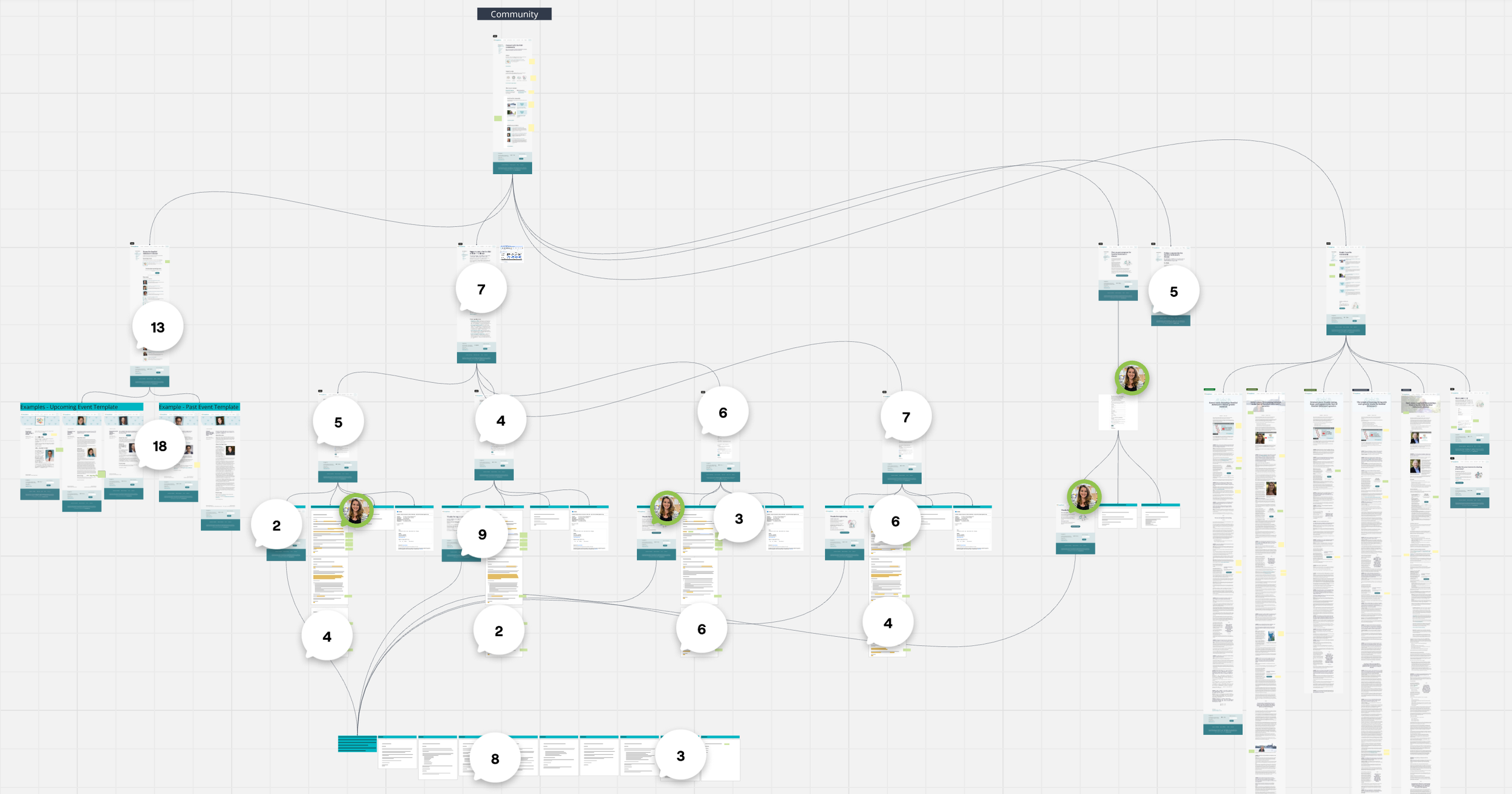
Working sessions with Youngtimers leadership and volunteers used a shared Miro boards to align on the site map, homepage design, content priorities, and a fast-paced review process.
What we did
Our work spanned strategy, design, build, and the communications infrastructure behind the site:
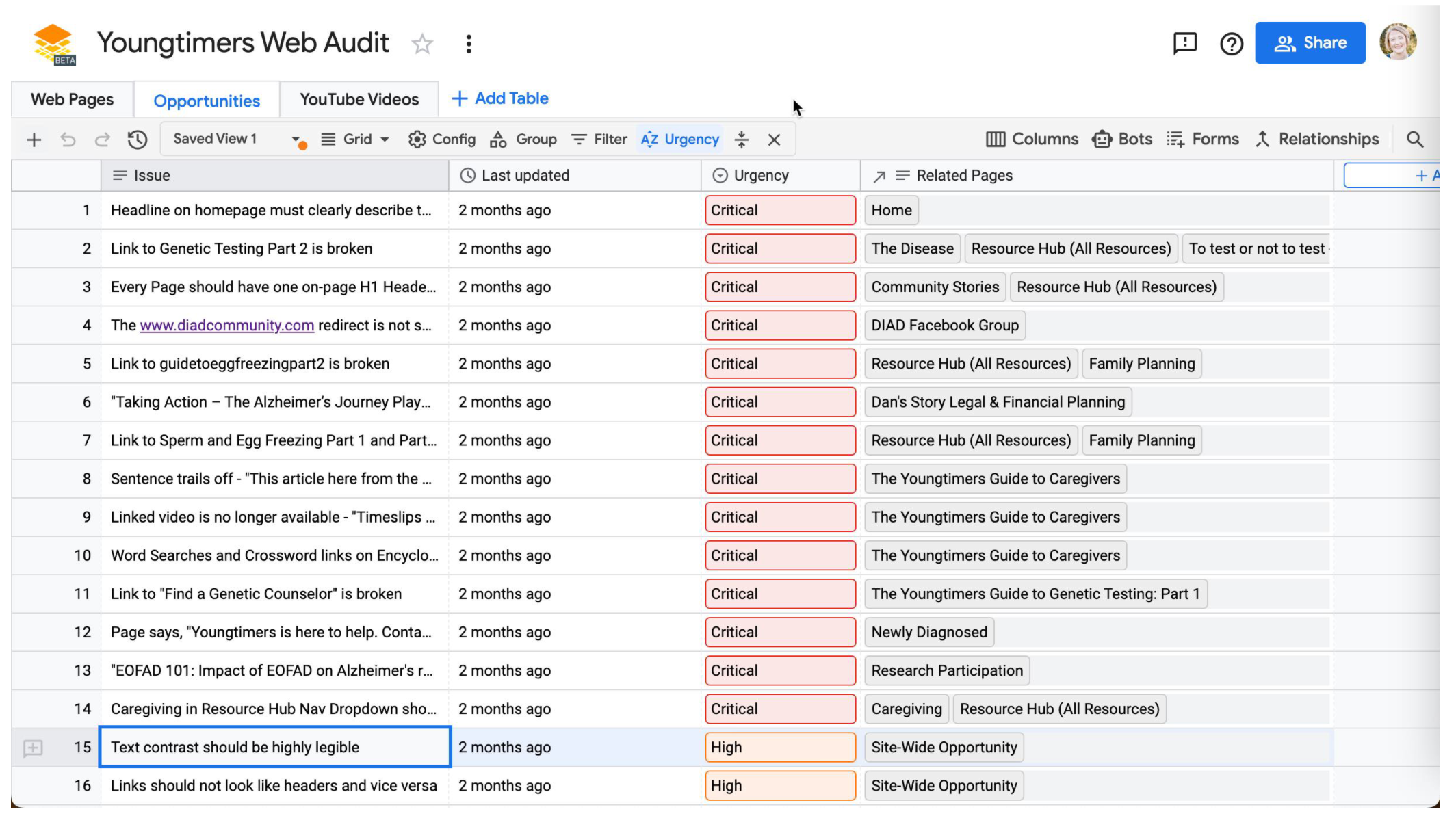
The UX Audit served as a checklist for what we needed to improve with the website rebuild.
UX Audit: We began with a structured audit of the existing website, identifying the barriers keeping families from finding support and keeping volunteers from maintaining content
Stakeholder Alignment & Information Architecture: Through facilitated working sessions with board members and volunteers, we aligned on a site map built around the real stages of the FAD journey: people newly learning about the disease, at-risk and asymptomatic individuals, symptomatic community members, caregivers at every stage, plus researchers and donors
Nonprofit Landscape Review: We studied websites from other nonprofits, patient advocacy groups, and disease communities to learn what works and what doesn't for organizations like Youngtimers, from how they organize dense medical content to how they invite people into community and giving
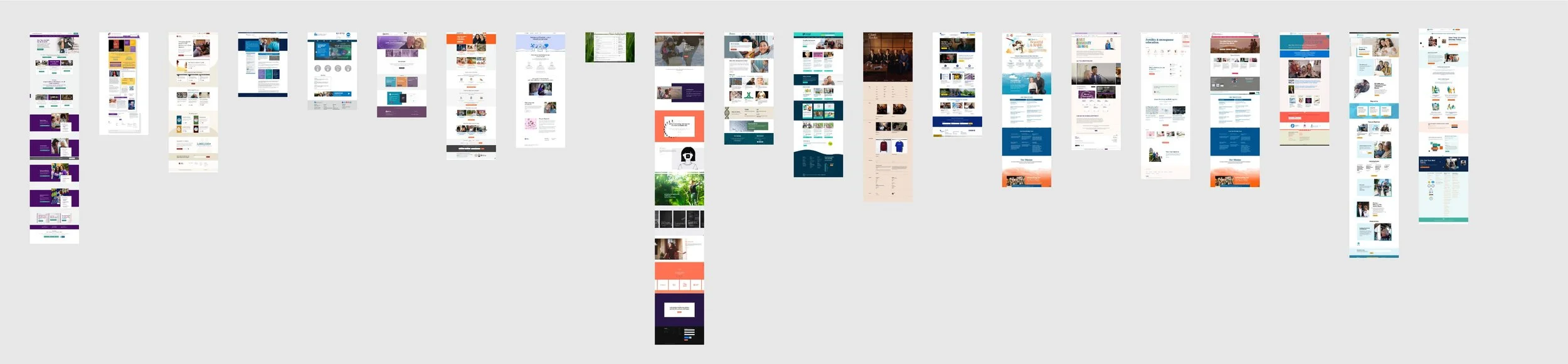
Analyzing the websites of other nonprofits helped us get crisp about what techniques would and wouldn’t work for Youngtimers.
Accessibility Standards: We identified both visual and copywriting accessibility standards to improve ease of use for users of all types, including those with older eyes or those for whom English was not the first language
Content Strategy for Cognitive and Emotional Strain: FAD science is dense and the audience is often reading in distress. We established voice and tone guidelines, a content tracking system for volunteer contributors, and a plain-language approach that translates research, biomarkers, and trial information for families without dumbing it down
Website Design & CMS Build: We designed and built the site in Squarespace so a volunteer team could own it, with page templates for guides, community stories, events, and support group listings, and Spanish-language content to serve FAD families globally
Digital Communications Platform: We stood up the full communications stack behind the site: Bloomerang CRM integrated with Qgiv donation processing, so support group registrations flow automatically into segmented reminder lists, new subscribers receive an automated welcome series, and donors get immediate acknowledgment with recurring giving support
Video & Content Pipeline: We built the workflow for turning webinars and expert interviews into an ongoing library of YouTube videos, guides, and community stories, so a lean team can keep publishing
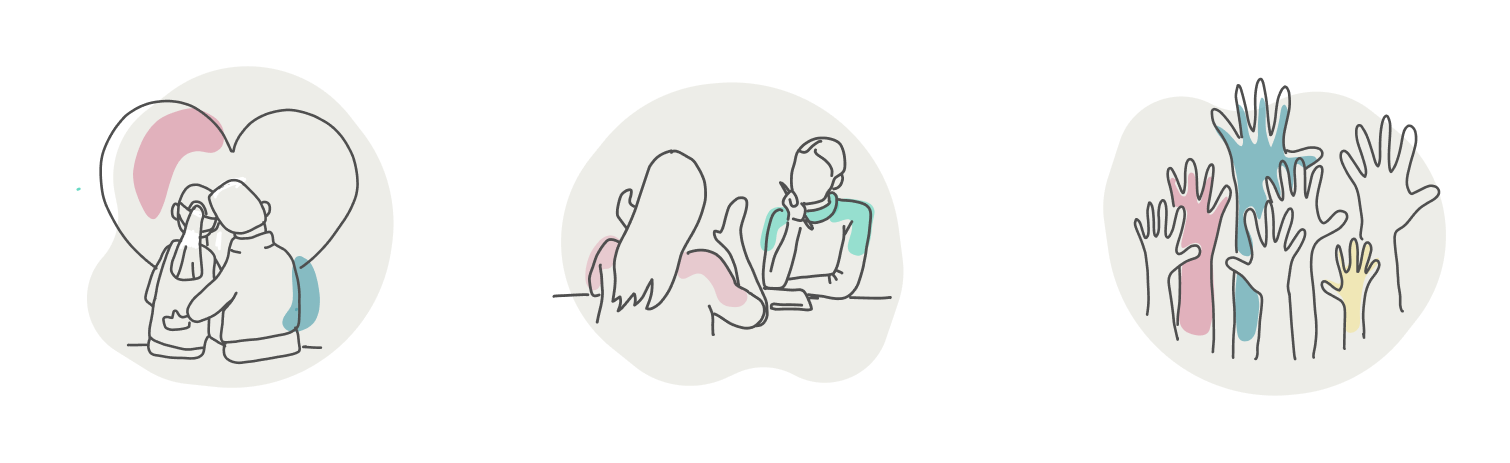
The team felt it was important to have a human touch on the website, but many members of the FAD community aspire to remain private. That’s why we produced hand-drawn illustrations that convey humanity without identifying any real individuals.
The results
The new youngtimers.org launched in mid-2025, and the platform behind it has been compounding value ever since:
The design system includes email templates that reinforce the brand aesthetics of the website.
A living resource library of more than 130 pages covering diagnosis, genetic testing, family planning, caregiving, legal and financial planning, and research participation, with new guides and research explainers published every month
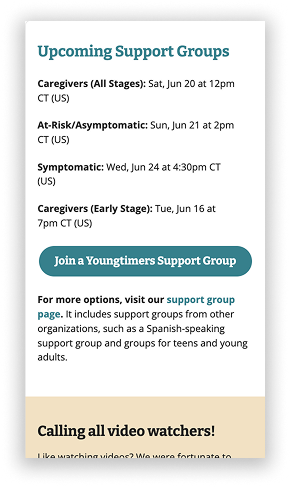
Automated constituent management: Website registrations flow directly into Bloomerang, and every support group gets automated, segmented reminders three days out and day-of. We’ve averaged 25 new contacts per month in the CRM, most of who also subscribe to the monthly newsletter.
A donor pipeline connected to the mission: Integrated donation processing, automatic acknowledgment, and recurring giving mean an organization mostly run on volunteer labor can steward donors like a fully staffed one
Global reach: Community members around the world now find Youngtimers through the site, join support groups, and step into advocacy roles. Spanish-language content, developed for both Mexican and global Spanish-speaking audiences, extends that reach across continents
New content: Because the site is so much easier to edit, we’ve been able to continue growing after launch, including features like a corporate partners page, an “In the News” section, a biomarker education series, and a steady cadence of community stories, all maintained by the organization.
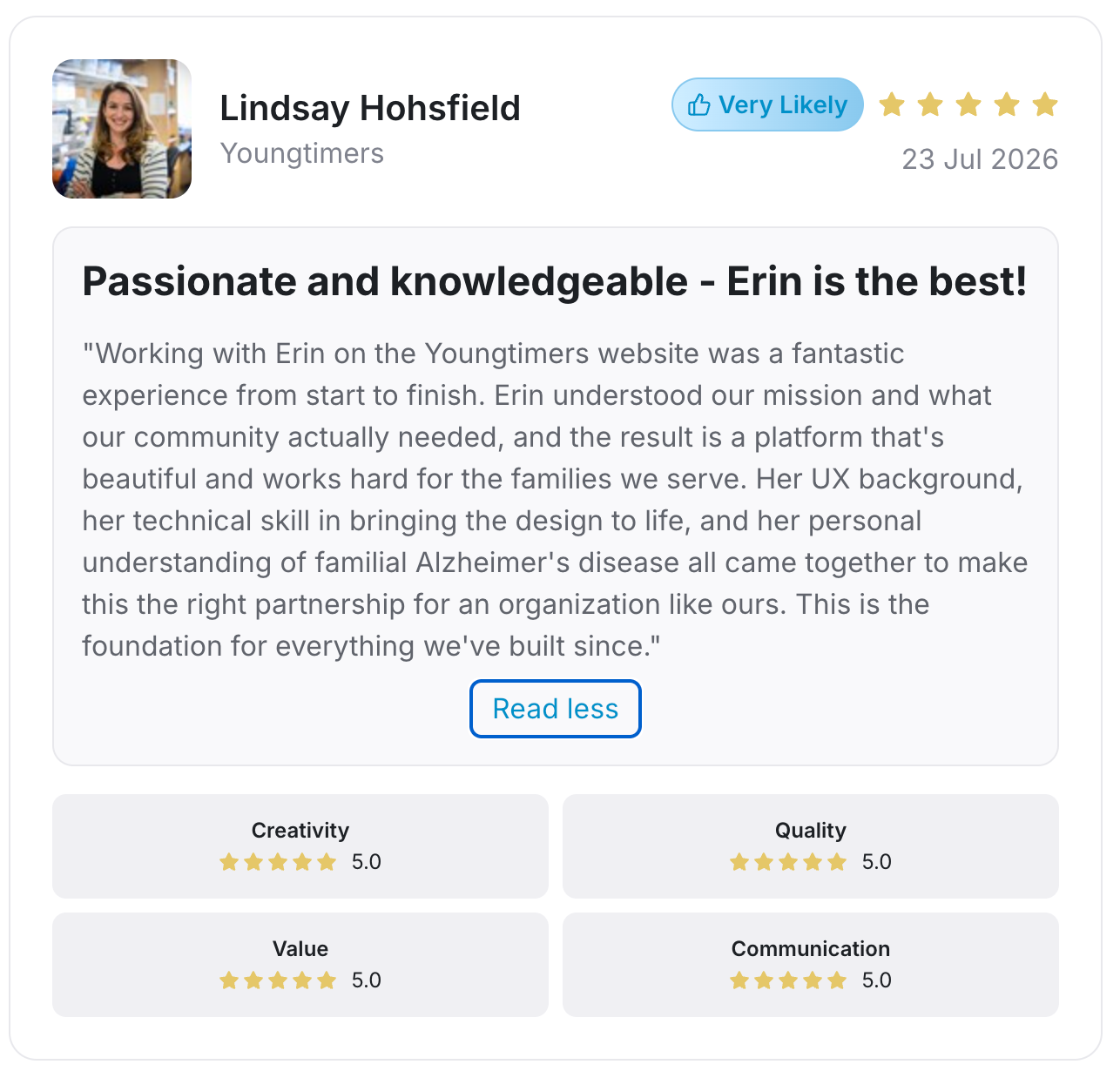
Looking back
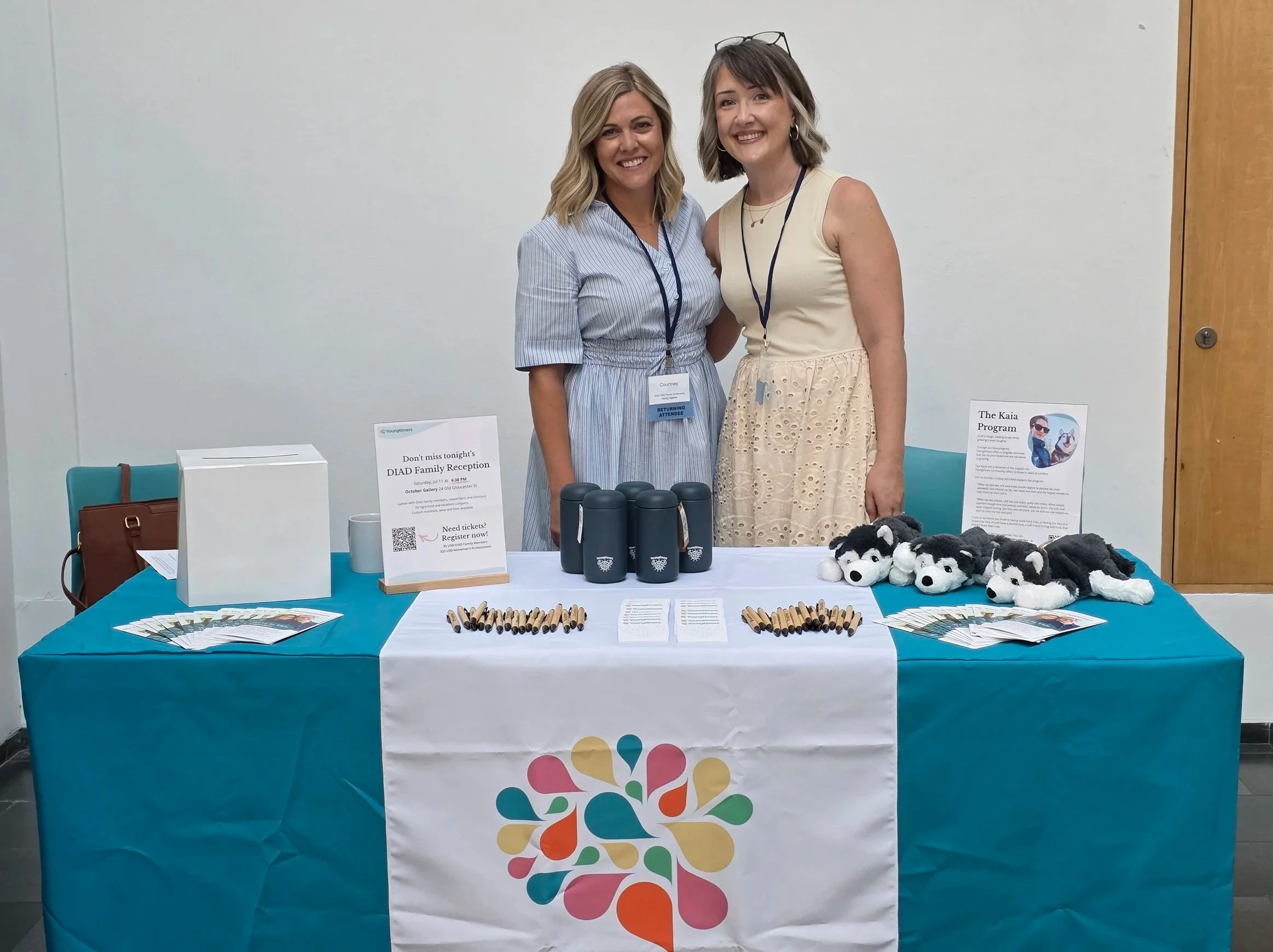
Erin poses with Courtney, Youngtimers’ first employee, as they work together at the Youngtimers table at the 2026 DIAD Family Conference in London.
This is the project that shaped Slide UX's focus on brain change, aging, and care.
Designing for the FAD community means designing for cognitive variability and emotional strain at the same time. The same page might be read by a person with early symptoms, their exhausted spouse, and a researcher evaluating whether the organization is credible. Every design decision had to serve all of them.
It also meant designing for organizational reality. Youngtimers runs on volunteers with day jobs and heavy caregiving loads. A beautiful website that requires constant expert attention would have failed within a year. So we treated the communications infrastructure as part of the design problem: the CRM, the automated reminders, the welcome series, and the content templates carry the operational weight, and the humans get to spend their limited hours on the community itself.
The platform is still growing, now sustained by our first actual employee. And Youngtimers is still the first place many families land after the hardest news of their lives. That durability is the outcome we're proudest of.
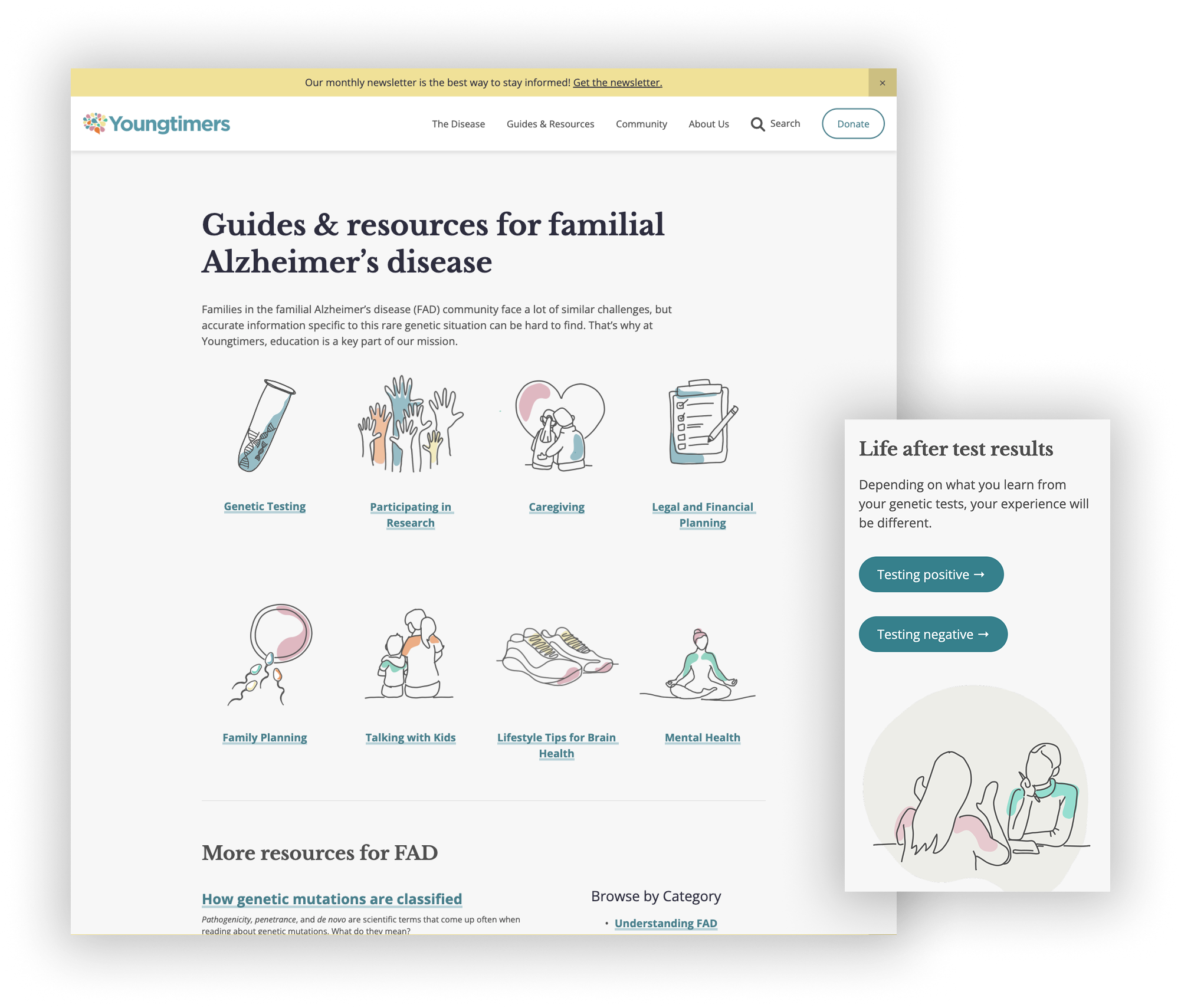
The new site organizes support around the stages of the FAD journey, with distinct guides for key challenges that face the community and automated support group registration for at-risk and asymptomatic individuals, symptomatic community members, and caregivers. Hand-sketched art makes the website highly recognizable.